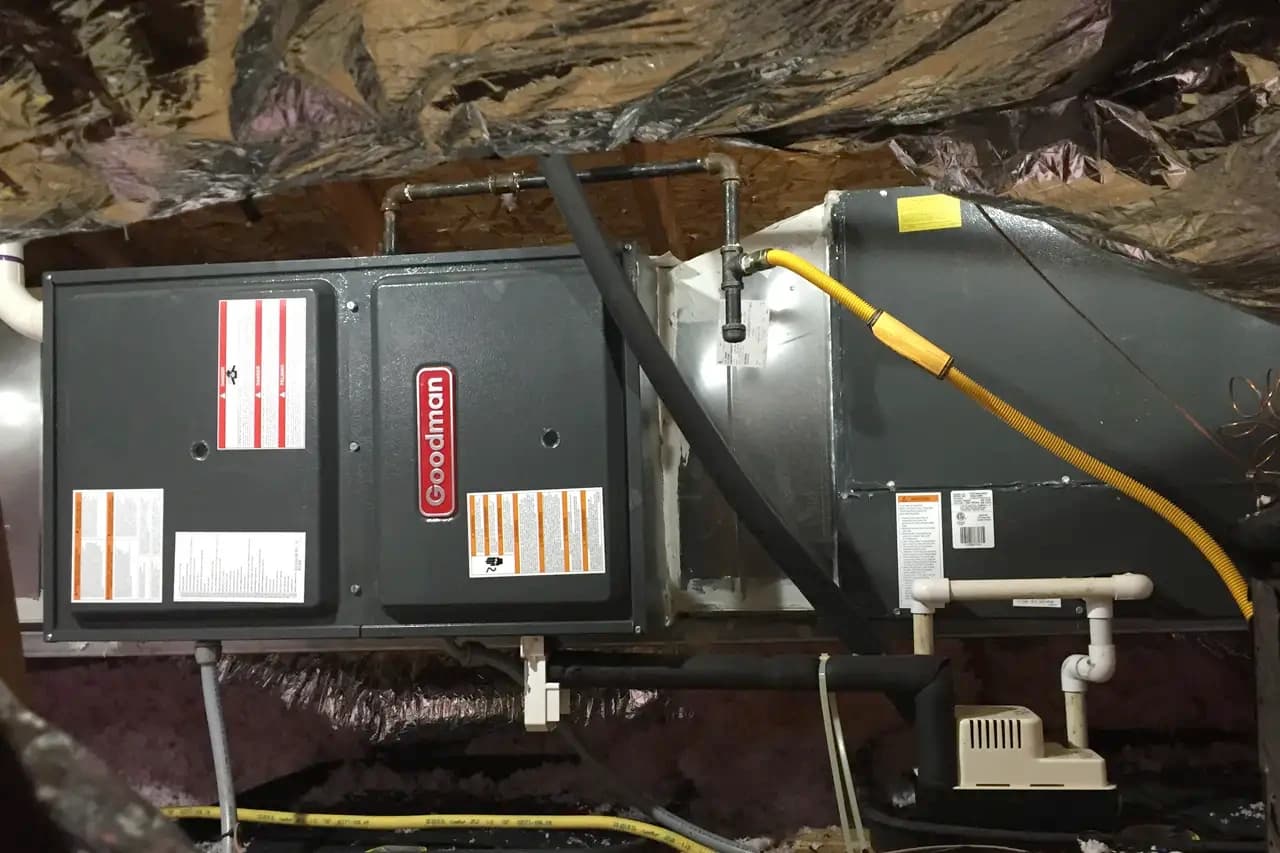
First: Shut the System Off
If water is actively pooling near your indoor unit or spreading across a ceiling below an attic air handler, turn the system off at the thermostat before anything else. Every additional hour of runtime produces more condensate and more damage. In the Inland Empire's dry heat this rarely becomes a mold problem overnight — but drywall, insulation, and subfloor damage add up fast.
Why an Air Conditioner Produces Water at All
Your evaporator coil runs below the dew point of the air passing over it. Moisture condenses on the coil, drips into a drain pan, and exits through a PVC condensate line to the outside or to a plumbing drain. A 4-ton system in August can produce several gallons a day even in our dry climate. When any part of that path fails, the water goes somewhere it shouldn't.
Cause 1: Clogged Condensate Drain Line (Most Common by Far)
Algae, dust, and biological slime build up inside the drain line over a season. Once it blocks, the pan overflows. This accounts for the majority of the "my AC is leaking" calls we take in July and August.
What you can check: find the PVC line exiting your air handler. There's usually an access tee with a cap near the unit. If water is standing in the pan and nothing is dripping outside at the termination point, you have a clog.
Temporary fix: a wet/dry vacuum held at the outdoor termination will often pull the blockage clear. Afterward, pour a cup of distilled vinegar into the access tee to slow regrowth. Do this monthly during cooling season and you'll likely never see this failure again.
Cause 2: Frozen Evaporator Coil
A coil that ices over will eventually thaw — and when it does, it dumps far more water than the pan was designed to hold. Signs: weak airflow at the registers, visible ice on the copper suction line, and air coming out that isn't actually cold.
Freezing has two root causes: restricted airflow (dirty filter, closed vents, collapsed return duct) or low refrigerant charge from a leak. Replace the filter, open all registers, and run the fan on ON with cooling OFF for two to three hours to thaw it. If it freezes again within a day, you have a refrigerant leak and you need a technician — adding refrigerant without finding the leak is throwing money at a symptom. Our AC repair team locates and repairs the leak before recharging, every time. There's more on this failure mode in our guide to an AC that runs but won't cool.
Cause 3: Rusted or Cracked Drain Pan
On systems past the 12–15 year mark, the secondary pan under an attic air handler can rust through or the primary pan can crack. The drain line is clear, the coil isn't frozen, and water still appears. This is a parts replacement, and on a system that old it's worth asking whether the money is better spent on replacement instead of repair.
Cause 4: Improper Installation
A drain line with insufficient slope, a missing P-trap, or an air handler that isn't level will leak intermittently from day one. If you've had this problem since the system was installed, it's not maintenance — it's workmanship. This is one reason we're careful about the details covered in choosing the right HVAC company.
The Safety Switch That Should Have Caught It
Code requires a float switch on attic and closet air handlers. When the pan fills, the switch cuts power to the system before the water overflows. If your pan overflowed and the system kept running, either the switch failed or it was never installed. Ask about it during your next service visit — it's an inexpensive part that prevents four-figure ceiling repairs.
When to Call Instead of DIY
- Water has already reached drywall, insulation, or flooring
- The coil refreezes after thawing
- You see oily residue near the coil or line set (a refrigerant leak indicator)
- The unit is in an attic and you can't safely access it
- The drain line is clear but water keeps appearing
Prevention Costs Almost Nothing
A seasonal tune-up includes flushing the condensate line, treating the pan, verifying float switch operation, and checking coil cleanliness — the four things that prevent this exact failure. The Department of Energy's guidance on maintaining your air conditioner lists drain maintenance among the highest-value routine tasks. See what's included in our HVAC maintenance plans.
Leaking Right Now? We Dispatch Same Day
We serve Perris, Moreno Valley, and every Inland Empire city with same-day diagnostic appointments during cooling season. Book online or call (951) 331-3310.
About the Author
Justin Jaszewski
Co-Founder & NATE-Certified Technician
Justin is the co-founder of It's No Sweat Heat & Air and a NATE-certified HVAC technician with over 25 years of hands-on experience across Moreno Valley and the Inland Empire. He leads the company's technical standards, trains every technician on the team, and personally inspects complex installations. Justin holds California HVAC license #1058772 and specializes in residential system design, load calculations, and energy-efficiency upgrades.