Eight Months Is a Long Time for a Gas Appliance to Sit
Inland Empire heating season is short. Most homes in Menifee, Murrieta, and Temecula run the furnace from late November to February and then ignore it completely. That is roughly eight months of a gas-burning appliance sitting in a hot, dusty attic or garage with nobody looking at it.
In that window, spiders nest in burner compartments, rodents chew duct insulation and low-voltage wiring, flue caps work loose in Santa Ana winds, and condensate lines on high-efficiency units dry out and clog. None of it is visible from the thermostat. All of it shows up on the first ignition.
Here is the walkthrough to do before the first cold morning, not during it.
1. Replace the Filter — Before the First Run
Start here, because it affects everything downstream. A filter that spent the summer catching Inland Empire dust is both a dust reservoir and an airflow restriction. Restricted airflow across a heat exchanger is the leading cause of overheating, short-cycling on the limit switch, and the kind of thermal stress that cracks exchangers.
Match the MERV rating to what your system can actually handle. Jumping a one-inch slot from MERV 4 to MERV 13 on an older system can choke it — we cover that tradeoff in the HVAC filter guide.
2. Look at the Burner Compartment
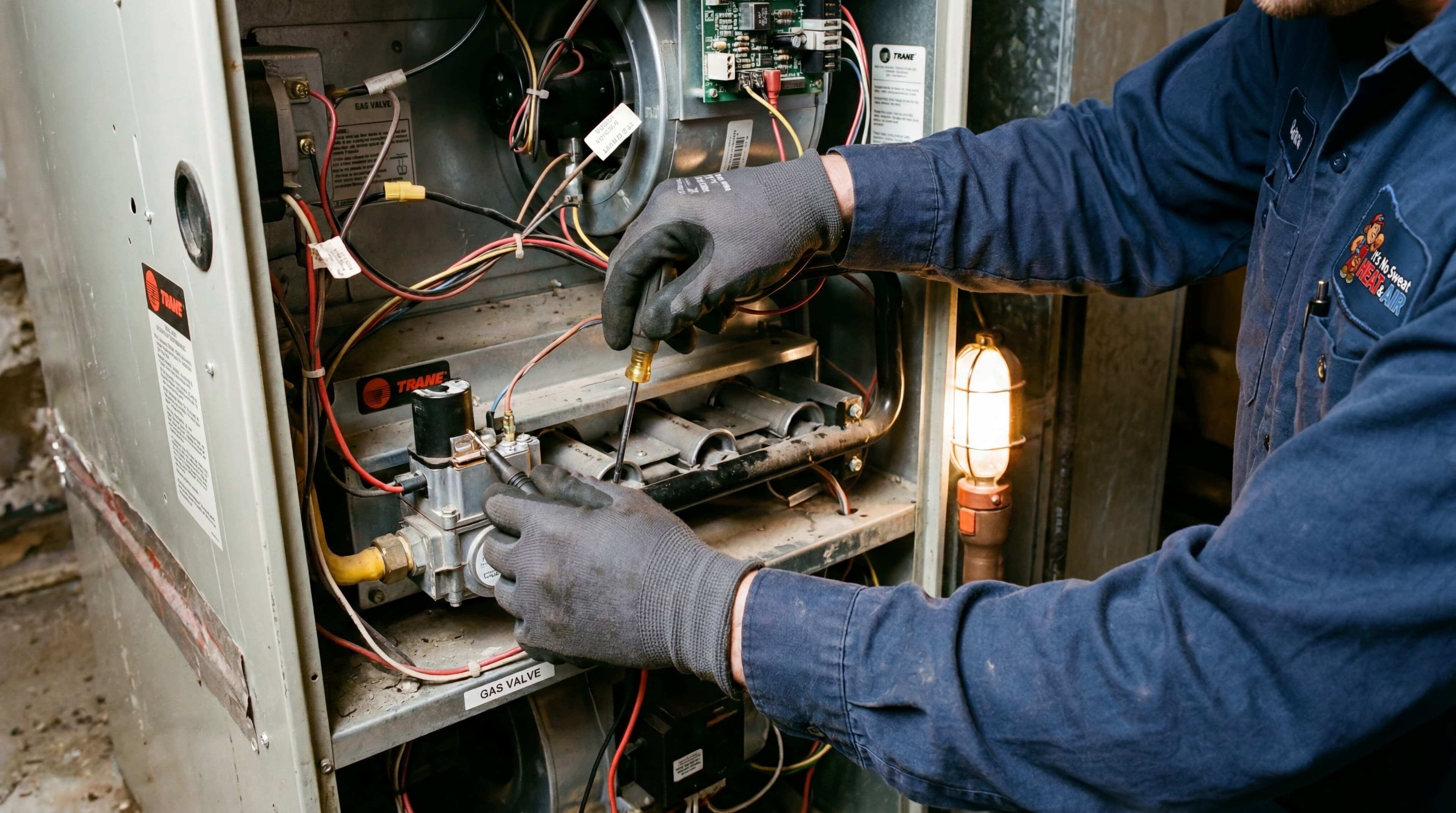
Pull the front panel. You are looking for three things: debris, rust, and soot. Dust and spider webs across the burners disrupt the flame pattern. Flaky orange rust on the exchanger or burner assembly is a sign of condensation and age. Black soot anywhere means incomplete combustion, which is the condition that also produces carbon monoxide.
If you see soot, stop the walkthrough and book a diagnostic. Do not run the system.
3. Check the Flue and Vent Termination
Go outside, or into the attic, and find where the flue exits. You are confirming it is still intact, still pointed where it should be, and not blocked. Santa Ana winds move rain caps. Birds build nests in B-vent terminations over the summer. On a high-efficiency unit with PVC sidewall venting, check that the intake and exhaust terminations are clear of leaves, mud dauber nests, and landscaping overgrowth.
A blocked flue is the single most dangerous condition on this list. It has no symptom you would notice until people in the house start feeling sick.
4. Test Every CO Alarm in the House
Press the test button on each one. Then check the manufacture date printed on the back — CO sensors degrade and most units are rated for 7 to 10 years regardless of battery condition. An expired alarm will still chirp when tested and still fail to detect carbon monoxide.
California requires CO alarms in dwellings with gas appliances, and the CPSC recommends one outside every sleeping area and on every level. Our carbon monoxide checklist goes deeper on placement.
5. Clear the Condensate Drain (High-Efficiency Units Only)
If your furnace has PVC venting and a condensate line, it is a condensing unit, and that drain sat dry all summer. Dried residue and dust turn into a clog, the pressure switch trips on the backed-up condensate, and the furnace locks out on the coldest morning of the year.
Flush the line before the season. If you have a condensate pump, confirm it actually runs — they fail silently.
6. Walk the Supply Registers and Returns
Over the summer, people close registers in unused rooms, push furniture against returns, and shut doors to rooms they are not cooling. All of it stays that way into heating season, and all of it raises static pressure.
- Open every supply register, including ones in rooms you do not use
- Pull furniture and rugs off return grilles
- Check the attic for ducts knocked loose or crushed during summer work up there
If some rooms never heat properly even with everything open, the problem is duct design or leakage, not the furnace. Start with our duct leakage guide.
7. Run It Deliberately, While You Are Paying Attention
Pick a mild afternoon in October, not a cold morning in December. Switch the thermostat to HEAT, set it about five degrees above room temperature, and stay nearby for a full cycle.
What you want to see and hear:
- Inducer motor starts, then ignition within 30 to 45 seconds
- Blower engages about a minute after ignition, not instantly
- Steady blue flames across all burners, no yellow tips, no flame rollout at the front
- A dusty smell that fades within thirty to sixty minutes — that part is normal, and we break down which furnace smells mean trouble
- No repeated ignition attempts, and no shutting off after a few minutes and restarting
Short-cycling, ignition retries, yellow flames, or a burning smell that will not clear all mean stop and get it diagnosed.
What This Walkthrough Cannot Tell You
Be honest about the limits. A homeowner inspection cannot evaluate a heat exchanger for hairline cracks, measure combustion efficiency or CO in the flue gas, verify gas manifold pressure, or measure static pressure. Those four things are where the genuinely expensive and genuinely unsafe problems hide, and all four require instruments.
If your furnace is over twelve years old, or if it has been more than two years since anyone put a combustion analyzer on it, the walkthrough above is a good start and not a substitute. The ENERGY STAR heating guidance recommends annual professional service on gas heating equipment for exactly this reason.
Get It Checked Before the First Cold Snap
October and early November are the right window — technicians are available, scheduling is flexible, and you are not competing with every other household in the county for the same emergency slot. A heating tune-up covers combustion analysis, heat exchanger inspection, gas pressure, safety switch testing, and static pressure. Our 5.0-star rated team handles HVAC maintenance across the Inland Empire. Book a heating tune-up or call (951) 331-3310.
About the Author
Justin Jaszewski
Co-Founder & NATE-Certified Technician
Justin is the co-founder of It's No Sweat Heat & Air and a NATE-certified HVAC technician with over 25 years of hands-on experience across Moreno Valley and the Inland Empire. He leads the company's technical standards, trains every technician on the team, and personally inspects complex installations. Justin holds California HVAC license #1058772 and specializes in residential system design, load calculations, and energy-efficiency upgrades.