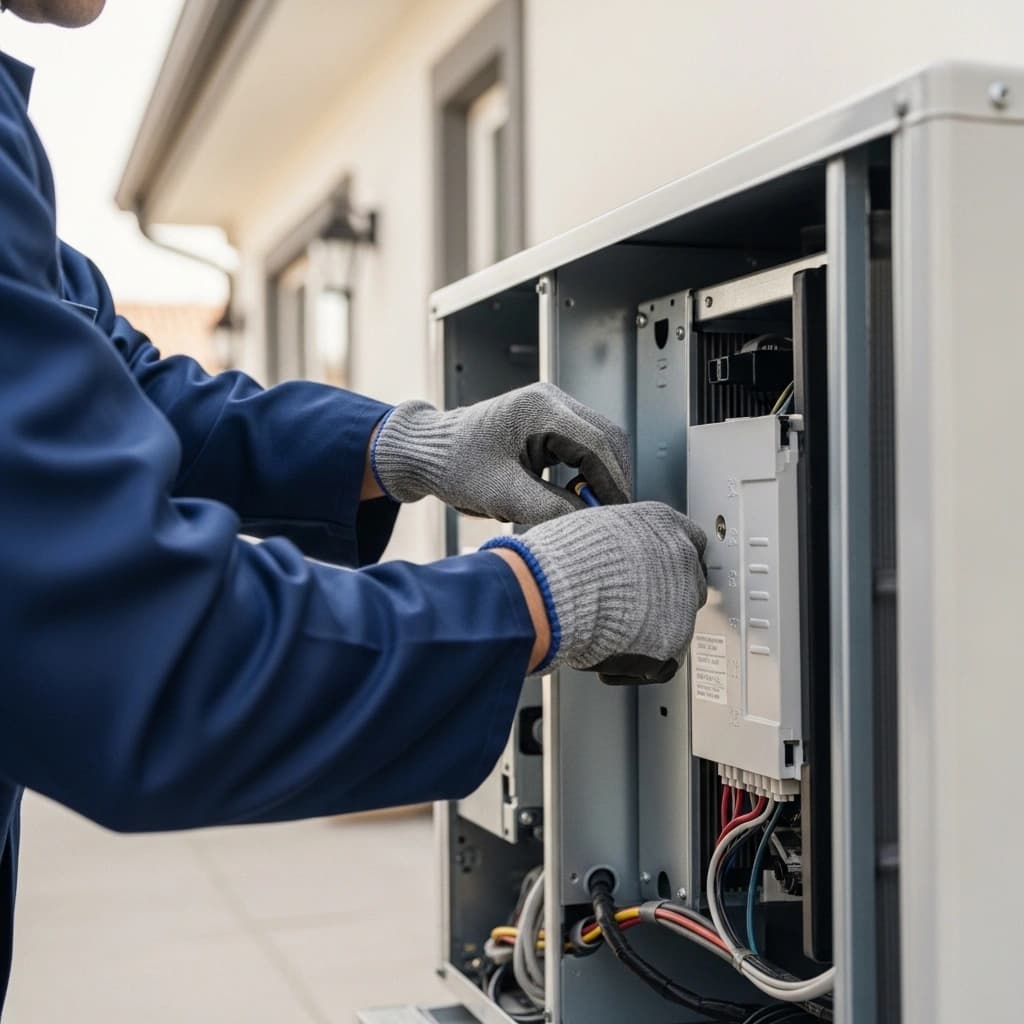
The National Number Is Wrong for Riverside County
Search how long an air conditioner lasts and you will get 15 to 20 years. That figure comes from national averages that blend Seattle and Minneapolis into the same pool as the Inland Empire, and it sets expectations that out here are simply not realistic.
In Riverside, Hemet, and San Jacinto, a well-maintained split system typically delivers 12 to 15 years. Neglected ones commonly fail between 8 and 11. We regularly condemn systems that a Bay Area homeowner would still be getting good service out of.
The difference is not build quality. It is runtime.
Why Inland Empire Systems Age Faster
Runtime hours, not calendar years
Equipment wears by hours of operation, not birthdays. A system in a coastal climate might log 700 cooling hours a year. An Inland Empire system in a home where the thermostat stays at 74 can log 1,800 to 2,500 — triple the wear on the same compressor and bearings. Thirteen calendar years here is mechanically equivalent to well past twenty somewhere mild.
Heat is hard on the condenser
Your outdoor unit rejects heat into the air around it. At 108°F the temperature difference it needs to work against shrinks dramatically, head pressure climbs, and the compressor runs hotter and longer to move the same amount of heat. Our stretch of 100-plus days in July through September is the single hardest condition a residential compressor faces.
Dust and the condenser coil
Fine Inland Empire dust, cottonwood, and landscaping debris pack into condenser fins and act as insulation on the exact surface that needs to shed heat. A coil at 40 percent blockage can push head pressure high enough to shorten compressor life by years. This is the cheapest, most ignored maintenance item there is, and we cover it in the heat wave prep guide.
Attic air handlers
Most homes out here put the air handler and a good share of the ductwork in an attic that hits 140°F in summer. That cooks blower motors, bakes duct mastic until it fails, and degrades insulation. If your ducts are up there, they are aging faster than your equipment.
Where Does Yours Stand?
Find the manufacture date rather than guessing. On the outdoor unit's data plate, the serial number almost always encodes it — many brands use the first four digits as week-and-year or month-and-year. If the plate is faded, the model and serial typed into the manufacturer's lookup page will get you there.
Then apply some honest brackets:
- 0 to 8 years — repair almost anything. You are well inside expected life.
- 9 to 12 years — repair, but start planning. Get the maintenance current and begin budgeting.
- 13 to 15 years — repair only if the fix is cheap. Any compressor or coil quote deserves a replacement comparison.
- 16-plus years — you are on borrowed time, and almost certainly paying a large efficiency penalty every month.
The Repair-or-Replace Math That Actually Works
The old rule of thumb multiplies the repair cost by the system's age and replaces if the result exceeds 5,000. It is crude, but it is directionally right and it is better than deciding emotionally at 4 p.m. on a 110-degree Friday.
Three things it misses, and all three matter here:
Refrigerant type. If your system runs R-22, production ended in 2020 and reclaimed supply is expensive. A significant R-22 leak on a 14-year-old system is usually the end of the conversation.
Operating cost. A 2009 system running at an effective SEER of 9 or 10 after years of coil fouling costs dramatically more per cooling hour than a modern one. In a climate with our runtime, that monthly gap is real money, not a rounding error. Our SEER2 explainer covers what efficiency actually pays back out here.
Failure timing. Systems fail under load, which means they fail in August — the worst week to be shopping, negotiating, and scheduling. That is the core argument in our piece on why the best time to replace an AC is when you do not need it.
How to Actually Get to 15 Years
Longevity out here is unglamorous and almost entirely about airflow and heat rejection:
- Change the filter on schedule. A one-inch filter in a dusty IE home needs attention every 30 to 60 days in cooling season, not annually.
- Rinse the condenser coil every spring. Power off, garden hose, from the inside out, no pressure washer.
- Keep two feet of clearance around the outdoor unit. Oleander hedges and lattice screens strangle airflow.
- Get static pressure measured once. Most underperforming systems out here are duct problems, not equipment problems, and high static pressure quietly shortens blower and compressor life. See our duct leakage guide.
- Book a spring tune-up. Catching a weak capacitor or a low charge in April prevents the compressor damage that shows up in August. April is the right month.
- Do not set the thermostat to 68. Asking for a 40-degree split on a 108-degree day means the system never cycles off. Every hour of that is life you are spending.
The federal Department of Energy maintenance guidance makes the same point: neglected systems lose efficiency steadily and fail early, and the maintenance that prevents it is cheap by comparison.
Find Out Where Your System Really Is
A straight answer beats guessing from a serial number. Our technicians measure refrigerant charge, static pressure, amp draw against nameplate, and temperature split, then tell you honestly whether you are looking at three more years or ten. If replacement is the right call, you get real numbers — and if it is not, we will say that too. Our 4.9-star rated team covers AC installation and repair across the Inland Empire. Request a system assessment or call (951) 331-3310.
About the Author
Justin Jaszewski
Co-Founder & NATE-Certified Technician
Justin is the co-founder of It's No Sweat Heat & Air and a NATE-certified HVAC technician with over 25 years of hands-on experience across Moreno Valley and the Inland Empire. He leads the company's technical standards, trains every technician on the team, and personally inspects complex installations. Justin holds California HVAC license #1058772 and specializes in residential system design, load calculations, and energy-efficiency upgrades.