
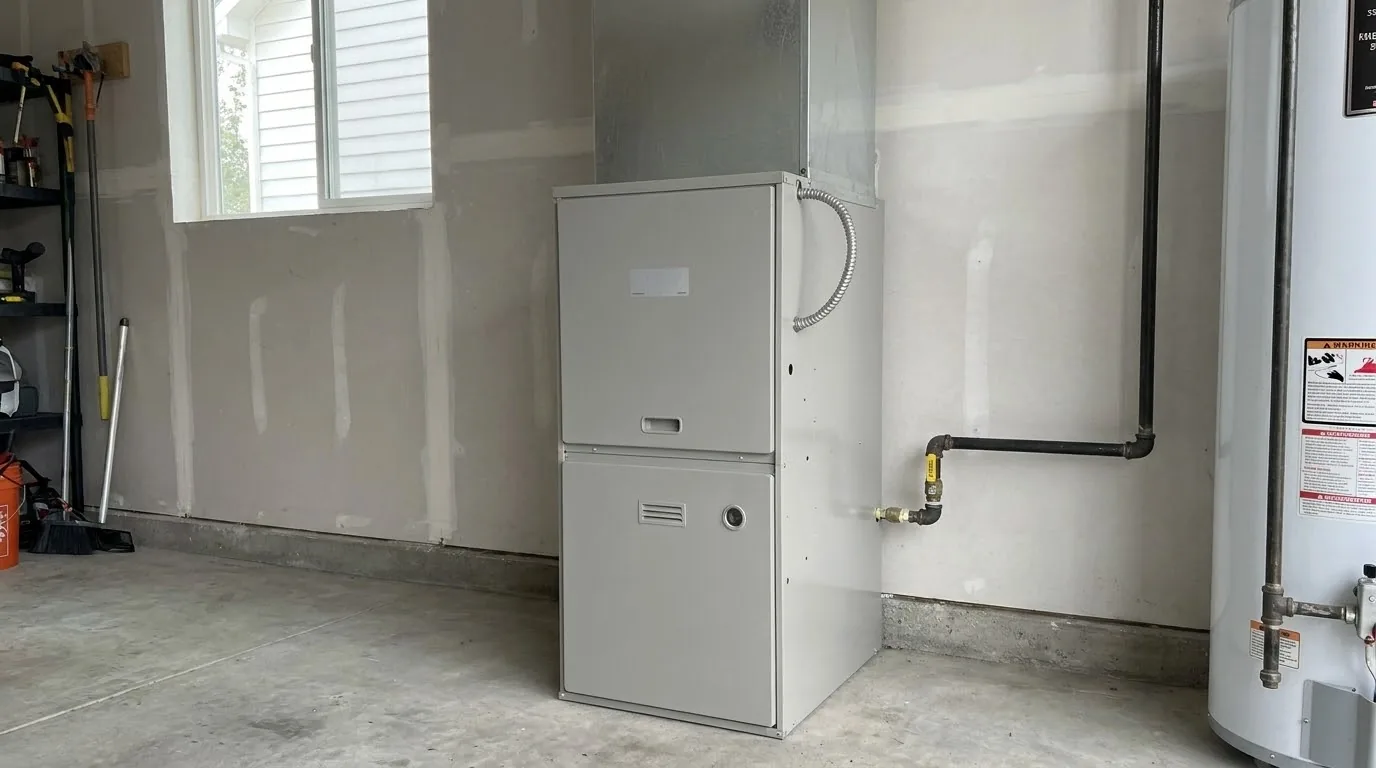
The Short Answer: $4,500 to $9,500 Installed
A standard gas furnace replacement in Riverside County runs $4,500 to $9,500 installed in 2026, and most homes land between $5,500 and $8,500. Jobs that cross $10,000 are almost always doing more than swapping a furnace — new ductwork, a venting change, or a move from a closet to an attic.
That range is wide because a furnace replacement is a project, not a product. The equipment is often less than half the invoice. What drives the rest is efficiency tier, how hard your install location is to work in, and what code requires once the old unit comes out.
What You Get at Each Price Tier
| Tier | Efficiency | Installed range | Who it suits |
|---|---|---|---|
| Single-stage, like-for-like swap | 80% AFUE | $4,500 - $6,500 | Straightforward replacement, existing venting reusable |
| Single-stage condensing | 95-96% AFUE | $6,000 - $8,500 | Most homeowners here; lowest gas use per season |
| Two-stage condensing | 96% AFUE | $7,500 - $10,500 | Two-story homes and uneven heat complaints |
| Modulating, variable-speed | 97%+ AFUE | $9,500 - $13,500 | Quietest operation, tightest temperature control |
California's minimum for a new gas furnace installation is 80% AFUE. Going to 95% or better means the furnace condenses its exhaust, which requires a PVC flue and a condensate drain the old unit did not have. That is the most common reason a quote comes in higher than the homeowner expected, and it is also where most of the operating savings come from.
The Line Items That Actually Move the Price
Venting changes. Moving from an 80% to a condensing furnace means abandoning the metal B-vent and running PVC to a sidewall or roof. Budget several hundred to a couple thousand depending on the run. If the old unit shared a flue with a water heater, that water heater now needs its own venting solution, which is a real and frequently missed cost.
Condensate drainage. A condensing furnace produces water. In a garage install, that is usually a short run to a drain. In an attic, it means a properly sloped line, a safety pan, and a float switch.
Install location. An attic install in a Menifee or Murrieta home with a tight scuttle access costs meaningfully more in labor than a garage unit at standing height. Access is one of the biggest swing factors between two quotes on the same equipment.
Ductwork. If the existing ducts are undersized, crushed, or leaking badly, putting a new furnace on them wastes the upgrade. We measure static pressure before quoting rather than discovering it afterward. Our duct leakage guide explains what that measurement reveals.
Permit and HERS testing. A mechanical permit is required in California, and changeouts generally trigger third-party HERS verification of duct leakage. Both are legitimate line items, not padding. Unpermitted furnace work causes problems with homeowners insurance and at resale.
Electrical and thermostat. Variable-speed equipment sometimes needs a dedicated circuit, and a modulating furnace needs a communicating thermostat to deliver what you paid for.
Why Riverside County Runs Above National Averages
National cost guides will quote you a lower number than you will get here, and the gap is structural rather than contractors taking advantage.
- Labor rates. Southern California trade labor sits well above the national median, and a furnace changeout is a full day for two technicians.
- Title 24. California's Building Energy Efficiency Standards impose requirements on duct sealing and verification that most states do not. That is real compliance work.
- Permit and inspection overhead. Pulling the permit, scheduling HERS, and meeting the inspector costs time on every job.
- Attic installs are the norm. Much of the housing stock here puts equipment in the worst possible place to work.
Rebates and Credits: Verify the Current Numbers Yourself
There is money available for high-efficiency equipment, but the amounts and eligibility rules change mid-year and we will not quote figures that may be stale by the time you read this. Two places to check before you sign anything: SoCalGas residential rebates for condensing furnace incentives, and the California Energy Commission for current state program status.
Federal tax credit terms for residential heating equipment have changed recently as well. Confirm what applies to your install year with your tax preparer rather than relying on a contractor's sales sheet, ours included. We help with rebate paperwork on qualifying equipment, but the eligibility determination is not ours to make.
Repair, or Replace?
The honest threshold: if the furnace is over 15 years old and the repair quote approaches half the cost of a comparable new system, replacement is the better value. Under 12 years with a cheap repair, fix it and move on.
Two things that push the math toward replacement regardless of age. A cracked heat exchanger is a safety condemnation, not a repair decision. And a furnace that has been short-cycling on its limit switch for a season has usually been damaged by the heat, even if it still runs — the symptom pattern is in our guide to a furnace blowing cold air.
If you are replacing the furnace anyway and the AC is of similar vintage, price both together. The labor overlaps and you avoid paying twice for the same access. Our AC replacement pricing breakdown covers that side, and our heat pump comparison is worth reading before you default to a gas furnace, because the economics out here are closer than most people assume.
Common Questions
How much does a new furnace cost in Riverside County?
Between $4,500 and $9,500 installed for most homes, with the majority landing between $5,500 and $8,500. An 80% AFUE like-for-like swap sits at the bottom of that range; a modulating 97% system with venting and duct work can reach $13,500.
Is a 96% AFUE furnace worth the extra cost here?
In the Inland Empire the honest answer is: less than in a cold climate. We run a short heating season, so the annual gas savings from 80% to 96% are smaller here than the brochures imply, and the payback is longer. The catch cuts the other way too — if the venting work is needed anyway, the incremental cost of the better equipment is small, and the comfort difference on a two-stage or modulating unit is immediately noticeable. We will show you both numbers.
How long does a furnace installation take?
One full day for a standard replacement. Add time if the job involves ductwork modification, a gas line change, or converting from metal venting to PVC for a condensing unit.
Do I need a permit to replace a furnace in California?
Yes. A mechanical permit is required and the work is subject to inspection by your local building department. We pull the permit and manage the inspection as part of every installation. A quote that is cheaper because it skips the permit is not actually cheaper.
Why are two quotes for the same furnace thousands apart?
Usually because they are not the same job. Check whether each includes the permit and HERS testing, venting changes, a condensate safety pan and float switch, old equipment disposal, and a labor warranty. Also check the AFUE and the staging — "96% furnace" covers single-stage, two-stage, and modulating units at very different prices. Our guide to evaluating an HVAC contractor lists what to verify before you sign.
What size furnace do I need?
Whatever a heating load calculation says, not whatever came out. Oversized furnaces short-cycle, heat unevenly, and wear faster. We run the load calculation on square footage, insulation, ceiling height, window area, and orientation on every install.
Get a Real Number for Your House
Every figure above is a range, and ranges do not tell you what your install costs. A free in-home estimate gets you a fixed price: load calculation, static pressure measurement, a look at your venting and access, and a written quote with the permit and testing included rather than discovered later. We will also tell you if the right answer is keeping the furnace you have for another two years. Our 5.0-star rated team handles furnace installation throughout Moreno Valley, Temecula, and the Inland Empire, and current promotions are on our special offers page. Request a free estimate or call (951) 331-3310.
About the Author
Justin Jaszewski
Co-Founder & NATE-Certified Technician
Justin is the co-founder of It's No Sweat Heat & Air and a NATE-certified HVAC technician with over 25 years of hands-on experience across Moreno Valley and the Inland Empire. He leads the company's technical standards, trains every technician on the team, and personally inspects complex installations. Justin holds California HVAC license #1058772 and specializes in residential system design, load calculations, and energy-efficiency upgrades.